
Recently we saw a news that Maharashtra 's Lonar lake colour changes to pink.
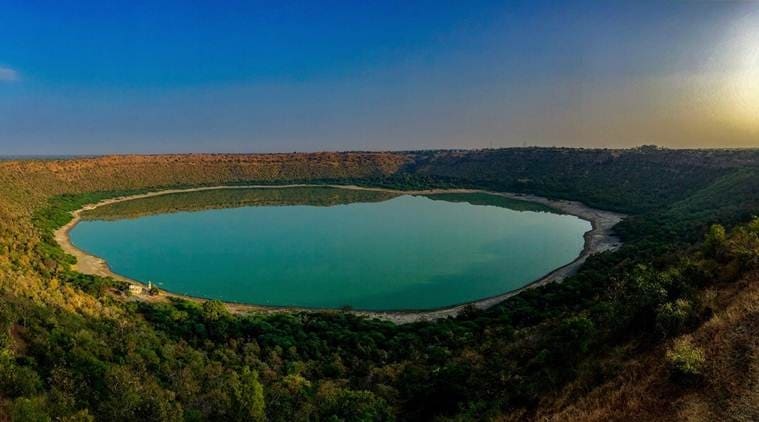


So today i will tell you more about the Lonar lake - facts & history
- Lonar Lake, also known as Lonar crater, is a notified National Geo-heritage Monument located in Buldhana district, Maharashtra. Lonar crater became a geo-heritage site in 1979
- Lonar Lake was created by an asteroid collision with earth impact during the Pleistocene Epoch. (50,000 year old lake)
- It is one of the four known, hyper-velocity, impact craters in basaltic rock anywhere on Earth. The other three basaltic impact structures are in southern Brazil.
- Lonar Lake has a mean diameter of 1.2 kilometers.
- The water in the lake is both saline and alkaline.
- The lake was first mentioned in ancient scriptures such as the Skanda Purana and the Padma Purana.
- The Ain-i-Akbari, a document written about 1600 CE
- The first European to visit the lake was a British officer, J.E. Alexander, in 1823..
- The area of 3.83Sq.km was declared as Lonar Wildlife Sanctuary by the government on 20 November 2015
- The lake is a haven for a wide range of plant and animal life.
- Resident and migratory birds such as black-winged stilts, brahminy ducks, grebes, shelducks (European migrants), shovellers, teals, herons, red-wattled lapwings, rollers or blue jays, baya weavers, parakeet hoopoes, larks, tailorbirds, magpies, robins and swallows are found on the lake.
- Among reptiles, the monitor lizard is reported to be prominent
- In case of a natural phenomenon, there are fungi which generally give a greenish colour to water most of the times.
Before
After
Experts say this is not the first time that the colour change has happened, but this time it is more glaring.
The lake has presence of salinity and algae both. During summer season when the water level declines, it leads to increased salinity and change in the behaviour of algae because of atmospheric changes
There are several examples of such a phenomenon across the globe due to high salinity and action by algae.But it needs to be confirmed based on scientific studies.
Maharashtra forest department, on Wednesday asked the National Environmental Engineering Research Institute (NEERI), Nagpur To assess why there has been a change in colour.
-Rohit Meena